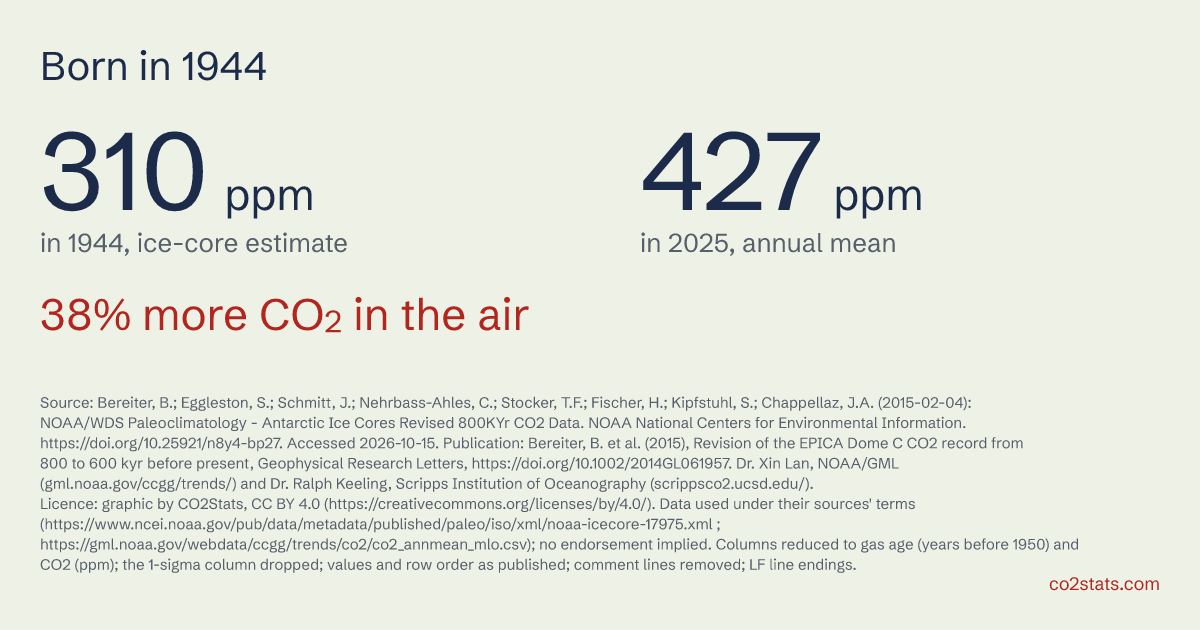
Born in 1944
310 ppmin 1944, ice-core estimate
427 ppmin 2025, annual mean
38% more CO2 in the air
In 1944 the air held 310.24 parts per million of CO2, an estimate from Antarctic ice cores (Bereiter et al. 2015), interpolated between the samples either side of the middle of that year.
In 2025, the latest complete year, the annual mean at Mauna Loa was 427.35 ppm: 38% more CO2 in the air. Figures from the data files retrieved 16 October 2026.
Sources and licences
- Antarctic Ice Cores Revised 800KYr CO2 Data (Bereiter et al. 2015 composite): age and CO2. Bereiter, B.; Eggleston, S.; Schmitt, J.; Nehrbass-Ahles, C.; Stocker, T.F.; Fischer, H.; Kipfstuhl, S.; Chappellaz, J.A. (2015-02-04): NOAA/WDS Paleoclimatology - Antarctic Ice Cores Revised 800KYr CO2 Data. NOAA National Centers for Environmental Information. https://doi.org/10.25921/n8y4-bp27. Accessed 2026-10-15. Publication: Bereiter, B. et al. (2015), Revision of the EPICA Dome C CO2 record from 800 to 600 kyr before present, Geophysical Research Letters, https://doi.org/10.1002/2014GL061957. Retrieved 15 October 2026. Access: no constraints (NCEI ISO metadata, accessConstraints "None"). Use: no restriction stated beyond citing the dataset (the metadata's "Cite as") and its publication (the file's citation note), and NOAA and NCEI's distribution and use liability disclaimers. Terms, full data file. Changes: Columns reduced to gas age (years before 1950) and CO2 (ppm); the 1-sigma column dropped; values and row order as published; comment lines removed; LF line endings.
- Annual mean CO2, Mauna Loa Observatory, Hawaii. Dr. Xin Lan, NOAA/GML (gml.noaa.gov/ccgg/trends/) and Dr. Ralph Keeling, Scripps Institution of Oceanography (scrippsco2.ucsd.edu/). Retrieved 16 October 2026. Made freely available to the public by NOAA GML, which asks users to give it fair credit with relevant citation text ("USE OF NOAA GML DATA" in the file header). No endorsement by NOAA is implied. Terms, full data file.
The card is licensed CC BY 4.0: share it with a credit and a link. The data keep their sources' terms, and no endorsement is implied.