The Kettle Question
In January 2009 this website was at the centre of a row about whether two Google searches boil a kettle. Seventeen years on, the same question is being asked about AI. Here is what the published figures say, and what they cannot.
2009: two searches and a kettle
On 11 January 2009 The Sunday Times reported that two Google searches from a desktop computer could generate about as much carbon dioxide as boiling a kettle for a cup of tea, and that a typical search generated 7 g CO2. Google answered on its official blog the same day: a mean of 0.3 Wh of energy and 0.2 g CO2 per search, counted in its data centres.
The physicist the paper had named, Alex Wissner-Gross, said his work had nothing to do with Google. His own figure was for the web as a whole: a mean of 0.02 g CO2 for each second spent visiting a website. He ran CO2Stats.com at the time, this site's predecessor; we say so because this essay is partly about this site's own past. The Times later clarified that its figure meant a search session of several minutes, not a single query, and quoted estimates of 1 to 10 g CO2 and 7 to 10 g CO2 that counted the computer on the desk.
The figures were far apart because they counted different things. That is still the whole story.
Seventeen years on: the same question about AI
In 2023 Alex de Vries estimated at most 2.9 Wh per ChatGPT request, from an analyst's assessment of its running costs. The International Energy Agency used 2.9 Wh per request in 2024, against a mean of 0.3 Wh for a Google search, as did the Electric Power Research Institute (2.9 Wh).
Then the figures came down. Epoch AI estimated 0.3 Wh for a typical GPT-4o query. OpenAI's chief executive wrote that the average ChatGPT query uses a mean of 0.34 Wh, with no method or boundary. Google published a median of 0.24 Wh for its median Gemini text prompt, with its method, and Microsoft researchers a median of 0.31 Wh for queries to the largest models.
A short chat is not the only thing people ask of AI. A long query to a reasoning model can take far more: a mean of 29.078 Wh for DeepSeek-R1 on its own servers, by one benchmark. An image took a mean of 2.907 Wh across eight open models, counting only the servers, and one five-second video from one model about 944.4 Wh.
Water is harder still. Google reports a median of 0.26 mL of water (consumption) per median prompt; OpenAI's chief executive a mean of 0.32 mL of water (kind not known); Mistral, counting the life cycle of its servers, 45 mL of water (consumption) for a 400-token response.
What the figures cannot tell you
Each figure counts something different. Some count only the chips, some the whole data centre, some the network or the screen in front of you. Many come from the companies that run the services, and some come with no method at all. Water can mean what a data centre draws or what it uses up, and often the source does not say which. One number per prompt hides how much depends on the model, the length of the answer and the hardware.
So the ledger below records each claim as it was made: its figure, what it counts, who made it and who paid, and anyone who disputes it. When a figure changes, the old one stays visible with its date.
How many make a kettle?
For one image to share: how many of each action use the energy it ideally takes to heat the water for one cup of tea, 24.7 Wh, by each source's own estimate.
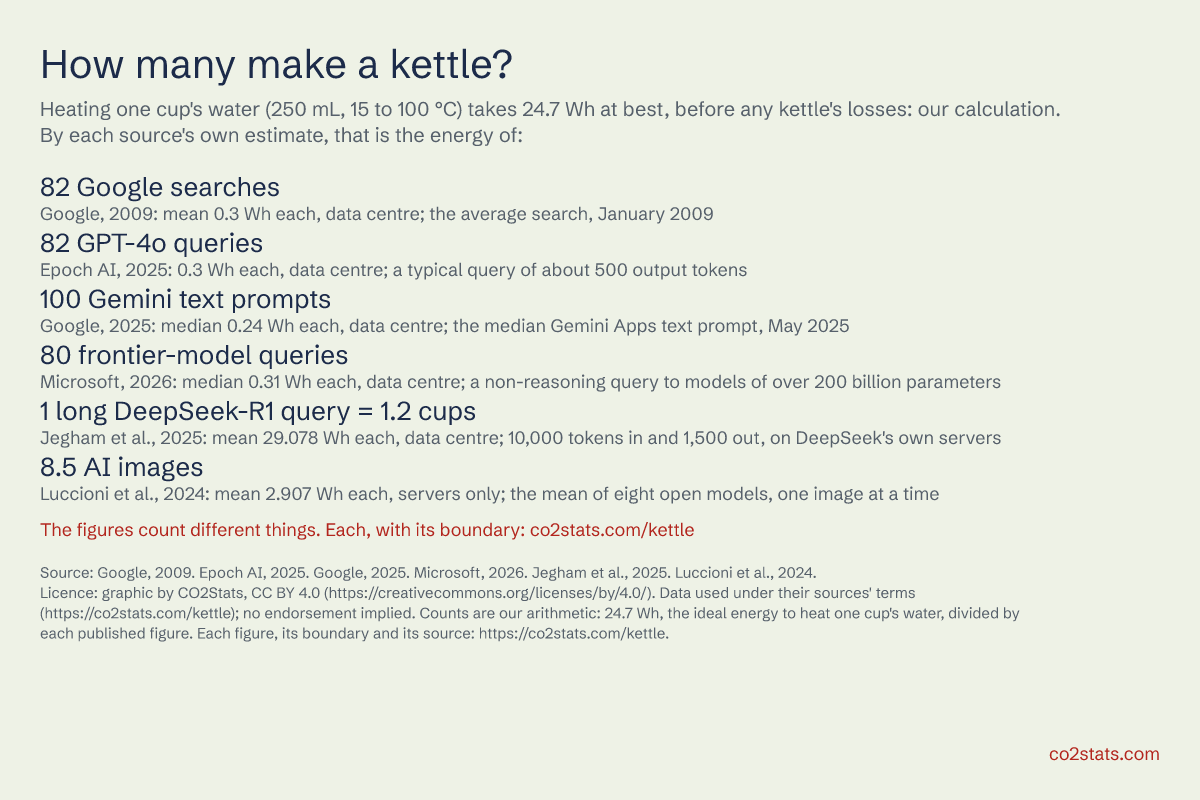
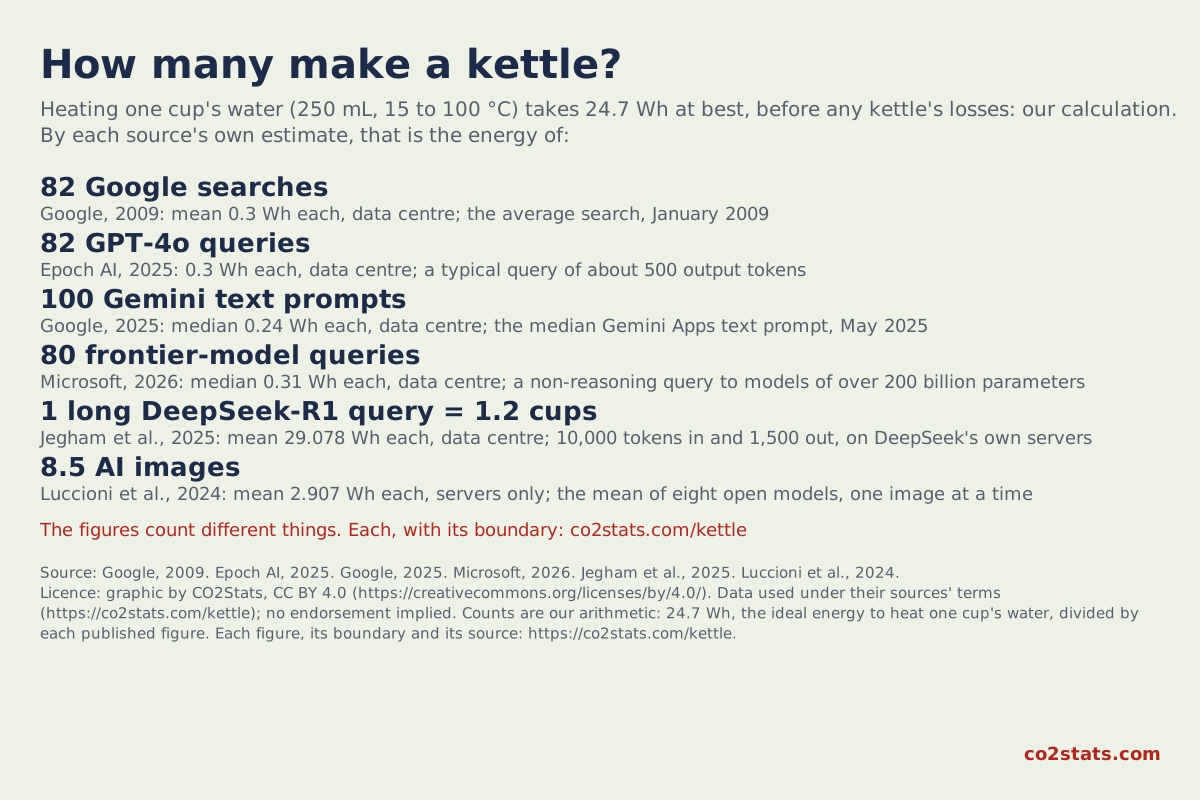
Heating the water for one cup of tea ideally takes 24.7 Wh. By each source's own estimate, that is the energy of about 82 Google searches (Google, 2009), 82 GPT-4o queries (Epoch AI, 2025), 100 Gemini text prompts (Google, 2025), 80 frontier-model queries (Microsoft, 2026) or 8.5 AI images (Luccioni et al., 2024); 1 long DeepSeek-R1 query takes about 1.2 cups' worth (Jegham et al., 2025). The estimates count different things; each row says what.
Show the data as a table
| Per cup of tea | Each, as published | What one is | Source |
|---|---|---|---|
| 82 Google searches | mean 0.3 Wh each, data centre | the average search, January 2009 | Google, 2009 |
| 82 GPT-4o queries | 0.3 Wh each, data centre | a typical query of about 500 output tokens | Epoch AI, 2025 |
| 100 Gemini text prompts | median 0.24 Wh each, data centre | the median Gemini Apps text prompt, May 2025 | Google, 2025 |
| 80 frontier-model queries | median 0.31 Wh each, data centre | a non-reasoning query to models of over 200 billion parameters | Microsoft, 2026 |
| 1 long DeepSeek-R1 query = 1.2 cups | mean 29.078 Wh each, data centre | 10,000 tokens in and 1,500 out, on DeepSeek's own servers | Jegham et al., 2025 |
| 8.5 AI images | mean 2.907 Wh each, servers only | the mean of eight open models, one image at a time | Luccioni et al., 2024 |
Heating one cup's water (250 mL, 15 °C to 100 °C) takes 4.18 J per gram per °C × 250 g × 85 °C = 88,825 J, or 24.7 Wh: the ideal, before any kettle's own losses. Our calculation.
- Average Google search, Google's 2009 figure
- Typical ChatGPT query on GPT-4o, Epoch AI estimate
- Median Gemini Apps text prompt, comprehensive boundary
- Frontier-scale model query on H100 nodes, Microsoft researchers' estimate
- Long DeepSeek-R1 query on DeepSeek's own servers, How Hungry is AI? benchmark
- Mean image generation across open text-to-image models, Power Hungry Processing
The image is licensed CC BY 4.0: share it with a credit and a link. Each figure keeps its source's terms.
The ledger
- An AI chat prompt
- An AI image
- An AI video
- A web search
- An hour of video streaming
- An email
- An hour of video calling
- A website visit
Work out your digital day: a year of your own prompts, searches, streaming and calls, from the approved figures.
Every change, with dates (also as RSS) and the ledger as open data.