GreenGeeks review
Verified greenchecked 16 November 2026What this means
LiteSpeed WordPress hosting from a host that says it buys renewable energy credits for three times the power it uses.
GreenGeeks gives you WordPress hosting with daily backups and free, unlimited WordPress and email moves. The Early Black Friday intro price needs a year paid upfront, and Lite then renews at $14.95 a month, nearly eight times as much. Prices are in US dollars.
At a glance
- Good for
- Small WordPress sites wanting low-cost hosting
- Not ideal for
- Anyone who wants to pay in pounds or keep a low price beyond the first year.
- Support
- 24/7 human support
- Money back
- 30 days
- Moving your site
- Free, unlimited WordPress and email moves
- Trustpilot
- 4.6 out of 5 from 1,743 reviews
Plans and prices
| Plan | Price | Websites | Storage | Backups | |
|---|---|---|---|---|---|
| Lite | from $1.95 a month tax not stated, Early Black Friday price, paid upfront for the first year, then $14.95 a month | 1 website | 25 GB SSD | Not known | Daily |
| Pro | from $3.95 a month tax not stated, Early Black Friday price, paid upfront for the first year, then $19.95 a month | Unlimited websites | 50 GB SSD | Not known | Daily |
| Premium | from $6.95 a month tax not stated, Early Black Friday price, paid upfront for the first year, then $31.95 a month | Unlimited websites | 100 GB SSD | Not known | Daily |
Pros and cons
Pros
- Daily backups on every plan
- Free, unlimited WordPress and email migration
- 25 GB of storage even on Lite
- 30-day money-back guarantee
Cons
- Lite renews at nearly eight times its intro price
- Intro price needs a year paid upfront
- Prices shown in US dollars
How green is GreenGeeks?
GreenGeeks is in the Green Web Foundation's directory of verified green hosting providers (we checked on 16 November 2026).
What the Foundation's verification means
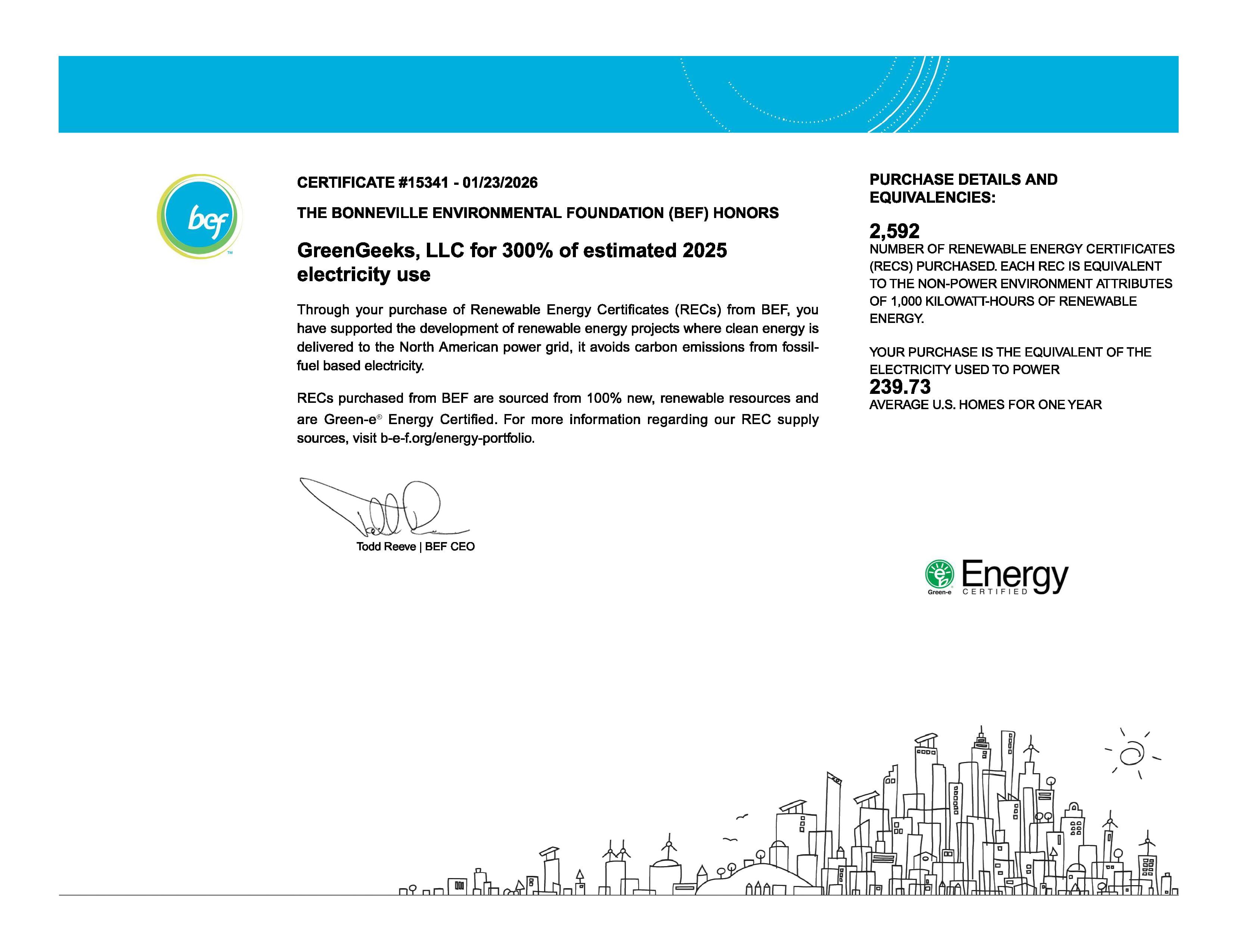
GreenGeeks says it buys renewable energy certificates equal to three times the electricity it estimates it uses, through the Bonneville Environmental Foundation, and its certificate covers 300% of its estimated 2025 use. The certificates are North American and bought separately from its power, so they add no clean supply at its data centres, two of which are in the Netherlands and Singapore. The 300% is three times an estimate, not a measured figure.
Four data-centre locations a customer can choose between; the operators are not named.
The data centres we list are in 4 countries, whose grids average 332 g CO2e per kWh, against 384 g in your country (United States). Lower is cleaner.
The grid in each country
| Country | Grid average | Year |
|---|---|---|
| United States | 384 gCO2e/kWh | 2025 |
| Canada | 192 gCO2e/kWh | 2025 |
| Netherlands | 254 gCO2e/kWh | 2025 |
| Singapore | 497 gCO2e/kWh | 2025 |
We last read GreenGeeks's own pages on 16 October 2026. Their pages: Going green, Renewable energy certificate from the Bonneville Environmental Foundation, Data center
Next to it in our ranking
- Kualo: verified green, grid average 301 g per kWh
- Reforest Hosting: verified green, grid average 301 g per kWh
- Hetzner: verified green, grid average 334 g per kWh
- Raidboxes: verified green, grid average 334 g per kWh
Listing data from the Green Web Foundation's Green Web Dataset, under the Open Database License (ODbL). Grid figures: Ember, Yearly electricity data (2026), CC BY 4.0.